
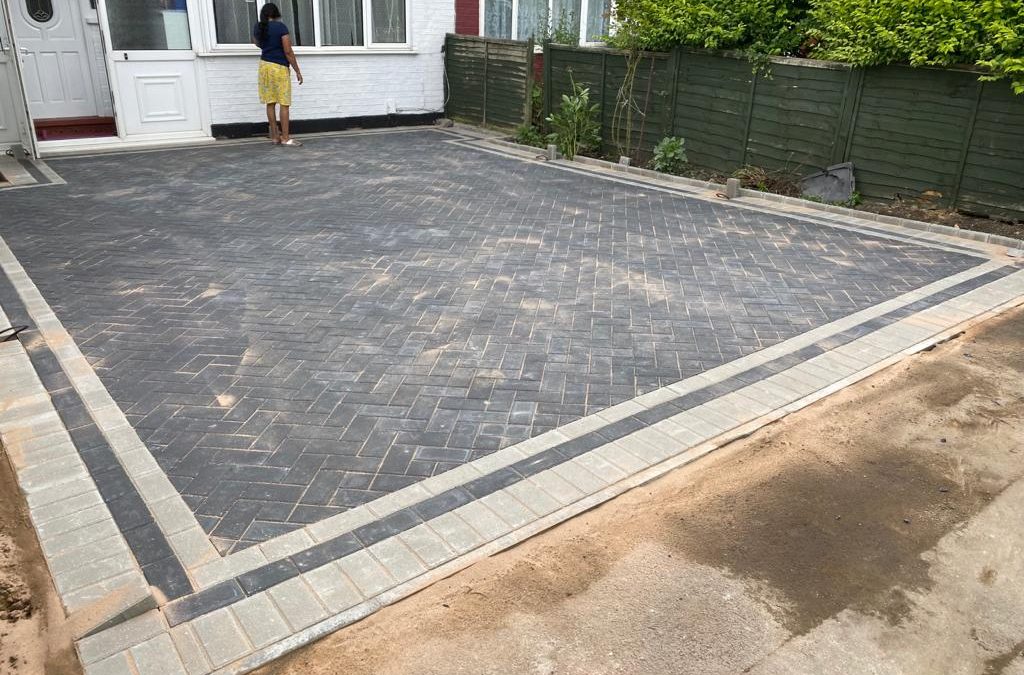
If you are planning a new driveway in East Grinstead, you have more choices, more rules, and more variation in contractor quality than most homeowners realise. This guide covers everything you need to know: the materials available, what they cost in the current market, when you need planning permission, what separates a driveway that lasts 30 years from one that crumbles in five, and how to choose a local contractor you can trust.
Most driveways in East Grinstead do not need planning permission, provided the surface is permeable or drains to a soakaway rather than the public road. Costs run from around £45 per square metre for tarmac up to £180 per square metre for premium clay block paving. Resin bound surfacing is the fastest-growing choice in the area because it is permeable, low-maintenance, and suits the mix of period and modern homes found across the RH19 postcode.
Why East Grinstead Homeowners Are Replacing Their Driveways
East Grinstead sits at the northern edge of the High Weald, and the clay-heavy soils that characterise much of West Sussex and the surrounding border with East Sussex and Surrey create specific challenges for driveways. Ground movement caused by shrink-swell clay, combined with the relatively high annual rainfall in this part of the Weald, accelerates the deterioration of surfaces that were not built on an adequate sub-base. The result is a significant number of driveways in the town that were laid 10 to 20 years ago on shallow foundations and are now showing cracks, sunken patches, and persistent weed growth through joints.
Beyond repair, the other driver of demand is off-street parking. Development in East Grinstead has outpaced road capacity in several residential areas, particularly around Imberhorne, Turners Hill Road, and the estates off Charlwoods Road. A well-designed driveway that accommodates two or more vehicles adds genuine, measurable value to a home in this market.
Aesthetics play a growing role too. Properties that were built in the 1960s and 1970s with concrete slab forecourts are being upgraded to resin bound or block paving finishes that complement more recent investment in windows, front doors, and landscaping.
Driveway Materials: Comparing Your Options for East Grinstead Homes
Each surface material has a different cost profile, lifespan, maintenance requirement, and planning implication. Understanding the trade-offs before you request quotes prevents the mistake of choosing on price alone.
Block Paving
Block paving remains the most popular choice for front driveways in residential East Grinstead because it offers the widest range of colours, patterns, and finishes, and it ages gracefully when installed correctly. Concrete blocks are the most common, typically costing £75 to £130 per square metre installed. Clay blocks, which are denser and more colour-stable over decades, run from £110 to £180 per square metre. The functional advantage that separates block paving from monolithic surfaces is the ability to lift and relay individual blocks if a service pipe needs to be accessed or if isolated damage occurs, without disturbing the rest of the drive.
Standard concrete block paving is not inherently permeable, so if the surface will drain towards the public highway, planning permission is required for areas over 5 square metres. However, permeable block paving systems are available from several manufacturers and satisfy SUDS rules without drainage infrastructure.
Resin Bound Surfacing
Resin bound driveways have grown significantly in popularity across East Grinstead and the surrounding villages over the last five years. The surface consists of natural aggregates or recycled glass mixed with a UV-stable polyurethane resin and trowelled to a smooth, seamless finish. Because the resin coats rather than fills the voids between aggregate particles, water passes through the surface naturally, making it inherently SUDS-compliant and avoiding the need for planning permission in most cases.
Installed cost in 2026 runs from £85 to £135 per square metre, putting a standard double driveway of 40 square metres in the £3,400 to £5,400 range fully installed. The surface is highly resistant to weed growth, quick to clean, and does not rut or crack in the way tarmac can under heavy vehicles if the sub-base was properly constructed. It is also available in a wide palette of natural stone colours, which suits the mix of sandstone and brick elevations common in East Grinstead’s older housing stock.
Tarmac
Tarmac is the most cost-effective hard-standing option and the fastest to install, often allowing a drive to be completed and in use within two days. At £45 to £75 per square metre, a double driveway costs roughly £1,800 to £3,000. Standard tarmac is impermeable, so drainage must run to a soakaway or garden rather than the highway to remain outside permitted development rules.
The weakness of tarmac is its sensitivity to installation quality. If the sub-base is shallow or poorly compacted, the surface will develop rutting under turning vehicle loads, cracking at the edges, and frost heave in hard winters. In East Grinstead’s clay soils, sub-base depth is not a corner to cut. A properly installed tarmac driveway on 150 to 200 millimetres of compacted MOT Type 1 aggregate will last 15 to 25 years; one laid directly over a shallow or unstable foundation may fail within five.
Gravel
Gravel is the lowest-cost option and is inherently permeable, so it raises no planning or drainage concerns. It suits longer rural approaches and properties where a softer, more traditional aesthetic is desired. The practical drawbacks are migration onto lawns and roads, displacement by vehicle tyres, and the need to top up with fresh aggregate every two to four years. Resin-bonded gravel, which binds the stones in place with a surface-applied resin, addresses the migration problem but does not share the through-drainage properties of true resin bound aggregate.
How Much Do Driveways in East Grinstead Cost in 2026?
Based on current contractor pricing across the RH19 postcode and the wider Surrey and West Sussex border area, the following figures reflect fully installed costs including excavation, sub-base, surface material, and site clearance. They do not include kerb replacement, lighting, or dropped kerb applications, which are costed separately.
For a single-car driveway of approximately 20 square metres: gravel £500 to £1,000, tarmac £900 to £1,500, block paving £1,500 to £3,600, resin bound £1,700 to £2,700. For a double-car driveway of approximately 40 square metres: gravel £1,000 to £2,000, tarmac £1,800 to £3,000, block paving £3,000 to £7,200, resin bound £3,400 to £5,400.
A dropped kerb application to your local highways authority adds £80 to £300 in application fees and £800 to £2,200 for construction, with processing times of four to eight weeks. If the existing driveway needs to be taken up to a greater depth due to poor ground conditions, or if significant root systems need to be removed, costs will increase accordingly. Always request an itemised quote that separates groundworks, materials, and disposal costs so you can compare like for like between contractors.
One consistent warning from independent cost guides in 2026: a quote that is 30 to 40 per cent below the other estimates almost always means the sub-base specification has been reduced. The surface material is the visible part of a driveway, but the sub-base is what determines how long it lasts.
Planning Permission for Driveways in East Grinstead: What the Rules Mean in Practice
Under permitted development rights that have been in place since October 2008, adding or replacing a front driveway in England does not require planning permission if the surface is permeable or if surface water drains to a lawn, garden, or soakaway rather than the public highway. This rule applies in East Grinstead as it does throughout England.
In practice, this means that resin bound surfacing, gravel, and permeable block paving systems can all be installed under permitted development without any application. Standard tarmac and standard concrete block paving on a surface that drains towards the road require a householder planning application if the area exceeds 5 square metres, which covers virtually any functional driveway.
East Grinstead has a number of conservation areas, including the town centre and parts of the historic core around the High Street. Properties within these areas face additional restrictions, and it is worth checking with Tandridge District Council or Mid Sussex District Council (depending on which side of the borough boundary you fall) before proceeding. Listed buildings require listed building consent for any external alteration and should be discussed with a conservation officer before any ground is broken.
The enforcement clock for planning breaches was extended from four years to ten years in 2024, so unpermitted work is a more significant long-term liability than it was previously. Getting the permissions right from the start protects both the property and its future saleability.
What Separates a Quality Installation from One That Fails Early
The visible surface of a driveway accounts for a fraction of the total cost. The majority of the budget goes into what no one will ever see: the excavation, the removal of unstable material, the compacted aggregate sub-base, and, where required, the edge restraints and drainage channels that keep the surface stable and water-free over decades.
In East Grinstead’s clay soils, the critical specification is sub-base depth. The standard recommendation is 150 millimetres of compacted MOT Type 1 crushed limestone for standard residential driveways, increasing to 200 millimetres or more where ground conditions are poor or where the drive will carry heavy vehicles. Contractors who skip or reduce this layer produce driveways that look good for two or three years and then begin to sink, crack, and develop water ponding.
Edge restraints, often called haunching, prevent the edges of block paving and tarmac from spreading under vehicle loads. Without properly set concrete haunching, edges crumble, weeds colonise the margins, and the structural integrity of the whole surface gradually unravels from the perimeter inward. Ask any contractor to confirm their sub-base specification and edge restraint method in writing before you sign a contract.
Drainage is the third element that separates good installations from poor ones. Every driveway needs a plan for where the water goes, whether through a permeable surface, a linear drain to a soakaway, or a channel that directs water to a suitable outlet. Water that has nowhere to go will find the weakest point in the construction and exploit it.
Why Benchmark Paving Is the Trusted Choice for Driveways in East Grinstead
Benchmark Paving serves East Grinstead as one of its primary service areas, alongside Croydon, Caterham, Oxted, Sevenoaks, and the surrounding communities of the Surrey and West Sussex border. The company installs the full range of driveway surfaces, including block paving, resin bound, tarmac, and gravel, across residential and commercial properties throughout the RH19 postcode and neighbouring areas.
Every project begins with a free site survey, giving homeowners a clear understanding of their ground conditions, drainage requirements, and the sub-base specification required before any price is agreed. Quotes are itemised so that the cost of groundworks, materials, and clearance are visible rather than bundled into a single figure that obscures where money is being spent.
Benchmark Paving backs its work with a 10-year guarantee and is fully insured for public liability, giving homeowners the assurance that both the installation process and the finished result are covered. The team handles projects from first survey to final clearance without subcontracting the work, which means accountability stays with one company throughout.
The gallery at benchmarkpaving.co.uk/gallery shows completed projects across the service area, including block paving and resin installations that reflect the architectural character of homes in East Grinstead and the surrounding villages. The driveways page sets out the full range of surfaces available, and the driveway repairs service covers restoration and patching for homeowners whose existing surface needs attention rather than full replacement. For homeowners considering complementary improvements, the patio installation service and landscaping team can coordinate front-of-house works as a single project.
To arrange a free, no-obligation survey for your East Grinstead property, visit benchmarkpaving.co.uk/contact-us or call the team on 0800 696 5894.
Frequently Asked Questions About Driveways in East Grinstead
How much does a new driveway cost in East Grinstead?
Costs vary by material and size. As of 2026, tarmac runs from £45 to £75 per square metre, resin bound from £85 to £135 per square metre, and block paving from £75 to £180 per square metre depending on whether you choose concrete or clay blocks. A typical double-car driveway of around 40 square metres comes to roughly £1,800 to £5,200 fully installed, including groundworks. Gravel is the most affordable option at £25 to £50 per square metre but requires topping up every two to four years.
Do I need planning permission for a driveway in East Grinstead?
Most East Grinstead homeowners do not need planning permission, provided the surface is permeable or drains to a garden or soakaway rather than the public highway. Non-permeable surfaces over 5 square metres that drain to the road require permission under rules in place since October 2008. Properties in conservation areas or with Article 4 Directions may face additional restrictions. A separate highways application is always needed for a dropped kerb, regardless of planning permission.
What type of driveway is best for a home in East Grinstead?
There is no single best material; it depends on your budget, kerb-appeal goals, and maintenance appetite. Resin bound surfacing gives a seamless, contemporary look and is inherently permeable, so it satisfies SUDS rules without extra drainage work. Block paving offers design flexibility and individual block replacement if damage occurs. Tarmac is the fastest to install and most budget-friendly. Gravel suits long rural drives but needs ongoing topping.
How long does driveway installation take in East Grinstead?
A standard residential driveway typically takes two to five days from excavation to completion, depending on size and material. Resin bound surfaces can be walked on within 24 hours of laying but benefit from 48 to 72 hours before vehicle use. Block paving installations on larger driveways may run to a week when re-pointing and sealing are included. Weather conditions, particularly frost and rain, can add a day or two.
What is a SUDS-compliant driveway and why does it matter?
SUDS stands for Sustainable Drainage Systems. A SUDS-compliant driveway allows rainwater to drain through or around the surface rather than running into the public highway and overwhelming drains during heavy rain. Permeable options such as resin bound, permeable block paving, and gravel all qualify. Choosing a SUDS-compliant surface in East Grinstead means you avoid the need for planning permission and contribute to local flood-risk management in this part of the Weald.
How long will a new driveway last?
Lifespan depends heavily on the quality of the sub-base and the material used. A properly constructed tarmac driveway lasts 15 to 25 years; resin bound surfaces 15 to 25 years with minimal maintenance; block paving 20 to 40 years; and quality clay block paving up to 40 to 60 years. Gravel has the shortest functional life, requiring topping every two to four years. Sub-base depth and compaction are the single biggest determinants of longevity regardless of surface type.
Does a new driveway add value to my home?
Yes, a well-installed driveway consistently adds value in the East Grinstead property market. Estate agents typically cite kerb appeal as one of the first things prospective buyers notice, and off-street parking is a significant draw in the RH19 postcode area where on-street parking can be limited. A quality block paving or resin driveway is widely regarded as returning 70 to 100 per cent of its cost in added property value, though exact figures vary by property type.
Can I have a driveway installed in winter in East Grinstead?
Tarmac and resin bound surfaces should not be laid in temperatures below 5 degrees Celsius or during frost, as cold conditions prevent proper curing and adhesion. Block paving can be installed year-round with experienced contractors taking precautions against frost heave in the sub-base. Many homeowners book winter surveys and schedule installation from March onwards. Gravel is the only material that can be laid in almost any dry weather conditions.
What happens to my old driveway surface during installation?
Existing surfacing is excavated and removed as part of the installation process. The depth of excavation depends on the ground conditions and the chosen material, typically 150 to 300 millimetres to allow for a compacted sub-base, a binder layer where required, and the surface material itself. Reputable contractors remove all excavated material from site, leaving the area clean. Ask your contractor whether skip hire or waste disposal is included in the quoted price.
How do I maintain a new driveway?
Maintenance varies by surface. Resin bound driveways need only occasional washing with a hose or pressure washer at low pressure to stay looking fresh. Block paving benefits from re-sanding the joints every three to five years and sealing every five to seven years to prevent weed growth and staining. Tarmac can be rejuvenated with a specialist sealant every four to five years. Keep drains clear of leaves and debris on any surfacing type to prevent water pooling and surface damage.
Ready to Start Your East Grinstead Driveway Project?
Whether you are replacing a tired concrete forecourt, converting a front garden to off-street parking, or upgrading to resin bound surfacing that matches your home’s kerb appeal, the first step is a no-obligation site survey that gives you a clear picture of what your project requires and what it will cost.
Benchmark Paving offers free surveys across East Grinstead and the surrounding area, with no pressure and no deposit required to secure your date. Call 0800 696 5894, email info@benchmarkpaving.co.uk, or use the contact form to arrange a convenient time.
For more information on driveway materials and installation, see the government’s guidance on when planning permission is required for home improvements, and the SusDrain guidance on sustainable drainage systems for homeowners and contractors.
